

In a an environment of capitalism, businesses are owned by the people. Where business decisions are made by the owners to provide both benefit to its customers and to the growth, sustainability, and profitability of the business itself.
After managing deca-million dollar per annum team budgets in my professional career I’ve come to the realization that personal finances aren’t a whole lot different than those of a corporation.
So here’s the case why we should run our personal finances like a business.
Growth
Invest in tomorrow, today. Successful companies all have one thing in common, they invest in their futures. Taking today’s profits to invest into tomorrow to further grow their business. In the landscape of personal finance growth should be a goal for everyone in any stage of their FIRE journey as well. Companies will invest in R&D spend or hiring or into new initiatives to grow their businesses. As individuals we can invest in real estate, stocks, ETFs, bonds, art, and other asset classes, but the main objective is to be committed and consistent with our investment to allow the power of compounding to grow wealth over time.
“Compound interest is the eighth wonder of the world. He who understands it, earns it…he who doesn’t …pays it”
Albert Einstein
Compound interest is something that’s universally praised but what exactly is it? It can be represented by the following mathematical equation
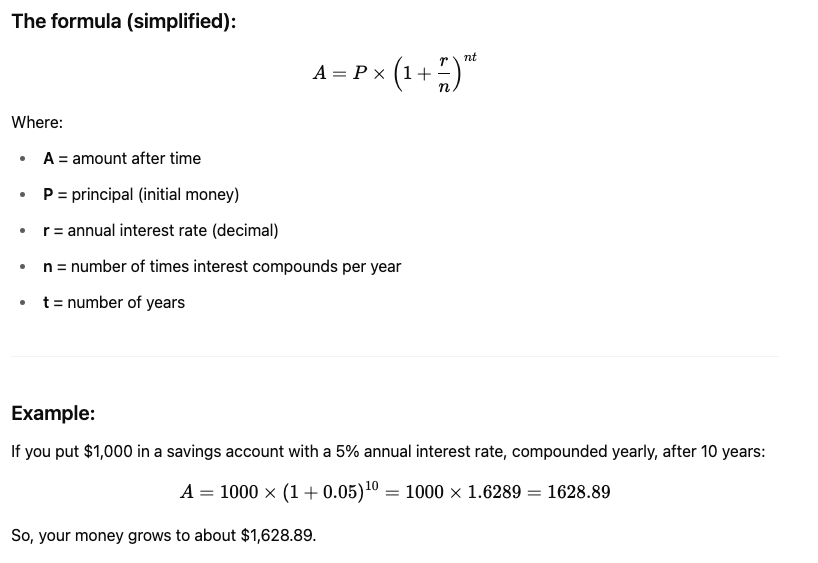
“Money makes money. And the money that money makes, makes money.”
Benjamin Franklin
Note that compounding works both ways – it can act to grow your wealth exponentially over time but it can also have the same effect on high interest debt! Be aware. If you have high interest credit card debt and only make minimum monthly payments the power of compounding will bury you in more and more debt over time.
Make smart decisions with your money to get the most out of compounding. We’ll cover growth in a bit more depth in an upcoming post centered around investing and asset allocation.
Profitability
Money in. Money out. All successful businesses from small to large understand their income and expenses to the dollar. Publicly listed companies on the major exchanges are required to publish this data on a quarterly basis. As a gross simplification, a company only remains solvent in the long term if they’re able to make more than they spend and this concept is directly transferable to personal finances.
Profit = Revenue – Expenses
Profitable companies are those whose income statements indicate a positive Profit, where their Revenue exceed their Expenses. This should be no different for you and I, our income (or revenue) is to exceed our expenses if we want to remain financially solvent. To gain a clear understanding of where stand with our finances we have to build a budget.
Call to Action: Take ownership of your personal budget. It maybe tedious at first but it does get better with time and with a consistent system. Account for each dollar that comes in and each dollar that goes out. If you’re like a successful business you’ll have more coming in than going out and if you find yourself in the reverse situation have read through my previous posts about eliminating unnecessary expenses to strengthen your personal income statement.
- To help you, I’ve created a useful budgeting sheet available here.
- Expenses: Second Last Through on Expenses post
- Expenses: Last Through on Expenses post
“Buy companies with strong histories of profitability and with a dominant business franchise”
Warren Buffet
Be a dominant franchise. Put yourself into a position of power, with the understanding and confidence that you’re bringing in more than what’s going out. Be profitable.
Sustainability
Once you have an understanding of your monthly inflows and outflows, extrapolate it over several months, quarterly, yearly. Aim for financial sustainability over long periods of time, where your income exceeds your expenses on any time frame. I encourage you to monitor your budget on a monthly basis to allow you agility to course correct if things aren’t tracking in the right direction. Look back every quarter and every year, just like publicly traded companies do to ensure your profitability is sustainable over long durations.
Once you’re in a position where your inflows consistently exceed your outflows we can retain a portion of the excess to drive future growth and profitability through investment.
Invest. Invest. Invest…But wisely.
Very rarely do strong businesses save and sit on piles of cash. They’re constantly investing to achieve compounding growth to drive business continuity (sustainability) which provides both societal and shareholder value. Value that’s fed back to its investors in form of stock price appreciation and dividends. If we build a sustainable financial model for ourselves only then can we take advantage of wealth building through investment. Whether the asset class we invest into be real estate, stocks, ETFs, bonds, art, and on and on.
We’ll visit risk and asset allocation in future posts. For now I encourage you to align your mindset to running your personal finances like a business.
Before you go…
A word from our sponsor! Wait….Still no sponsors, but I do have an exciting affiliate link! We all kick the bucket at some point — KindredBox offers a solution to help ease the transition for those that you leave behind. In their own words:
KindredBox is a digital vault designed to help individuals organize and secure their most important information for their loved ones. The platform offers a simple, secure, and affordable way to store and manage personal records, ensuring that all essential documents and information are easily accessible when needed. Key features include:
Step-by-Step Process: A simple, step-by-step process to help users collect and organize important records without needing technical or legal expertise.
Organized Interface: A clean and organized interface broken down into guided categories such as financial accounts, real estate, vehicles, digital/social accounts, health information, legal documents, memberships, and more.
Security: Industry-leading security technology to protect your information, ensuring it is encrypted and secure both in transit and at rest.
Trustee Access: Allows users to designate trustees who can access the information after the user passes away, providing peace of mind and reducing the burden on loved ones.
Learn more here:

2 comments On Run Personal Finances like a Business
Pingback: Calculating your FIRE number PART II: The Calculator – DelayedFI ()
Pingback: The Rate of Return Paradox – DelayedFI ()